Masjid al-Ghamama, Madinah: History, Location, and Ziyarat Visitor Guide
Just a short walk from Masjid an-Nabawi stands one of Madinah’s quieter but historically rich landmarks: Masjid al-Ghamama, often called the Ghamama Mosque or “Mosque of the Cloud.” For visitors building a Madinah Ziyarat itinerary, it’s an easy, meaningful stop that connects directly to events from the life of the Prophet Muhammad ﷺ.
What Is Masjid al-Ghamama?
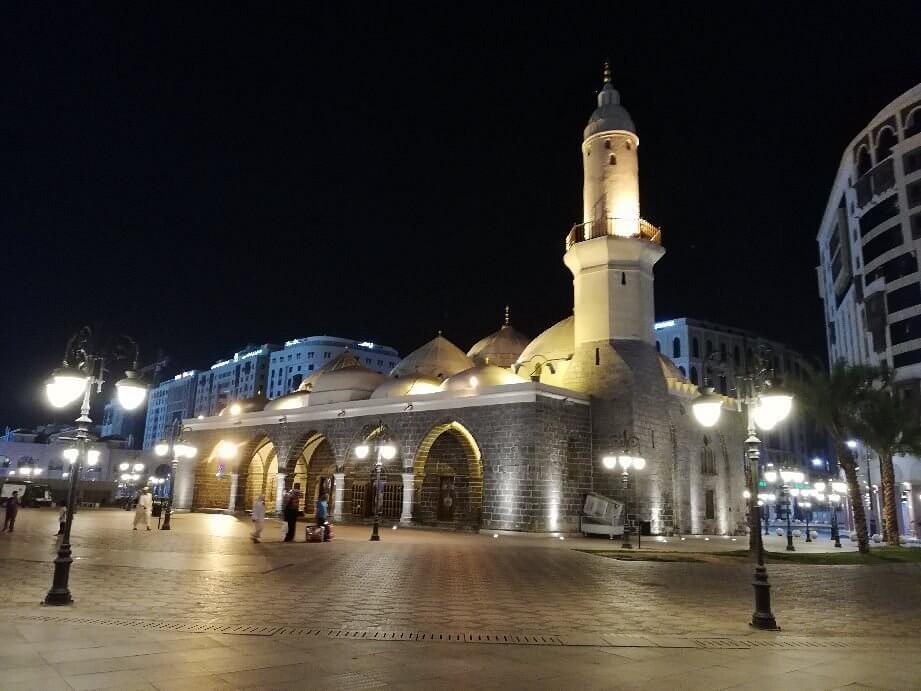
Masjid al-Ghamama (مسجد الغمامة) is one of the oldest mosques in Madinah, standing on ground long associated with communal prayer during the Prophet’s ﷺ lifetime. The area is reported to have been known as “al-Musalla,” an open prayer ground used by the Prophet ﷺ and the early Muslim community before a mosque was later built on the site.
Today it is recognized as one of Madinah’s historic mosques and a common stop for pilgrims and visitors exploring the city’s Islamic heritage sites, alongside places such as Quba Mosque and Masjid al-Qiblatain.
Why Is It Called “The Mosque of the Cloud”?
The word “ghamama” means cloud in Arabic, and the mosque’s name comes from a tradition connected to a specific event at this location. According to reports passed down in Madinah’s local history, the Prophet ﷺ came to this spot during a period of drought and led the community in Salat al-Istisqa — a prayer specifically asking Allah for rain. Shortly afterward, clouds are said to have gathered and rain fell, and the site became associated with that moment of relief.
It’s worth noting, as with much of Madinah’s oral and historical tradition, that these accounts are passed down through historical reports rather than documented with the same certainty as recorded events. Visitors should treat the story as part of the site’s rich local tradition rather than a formally established religious ruling.
The Historical and Religious Significance of Masjid al-Ghamama
The Eid Prayers
Multiple historical sources report that the Prophet ﷺ performed Eid prayers at this location during the later years of his life, when the growing size of the Muslim community in Madinah meant an open space was needed to accommodate the congregation. This is one of the reasons the site later came to be known locally as “Masjid Eid.”
Salat al-Istisqa (The Rain Prayer)
As noted above, this is the event most closely tied to the mosque’s name. Salat al-Istisqa is a recognized sunnah prayer performed in times of drought, and the tradition associated with this location is one of the most frequently cited stories connected to the site.
The Funeral Prayer for Najashi
Some historical reports also connect this location to the funeral prayer the Prophet ﷺ performed for Najashi, the ruler of Aksum (in present-day Ethiopia), who had sheltered early Muslim migrants fleeing persecution in Makkah and was said to have later embraced Islam. Since Najashi passed away in Abyssinia, this would have been a prayer performed in his absence — a practice known as Salat al-Gha’ib. As with other historical details tied to this site, sources describe this as a tradition associated with the area rather than a precisely documented fact, and readers researching the topic in depth should consult established Islamic historical references.
Architecture and What the Mosque Looks Like Today
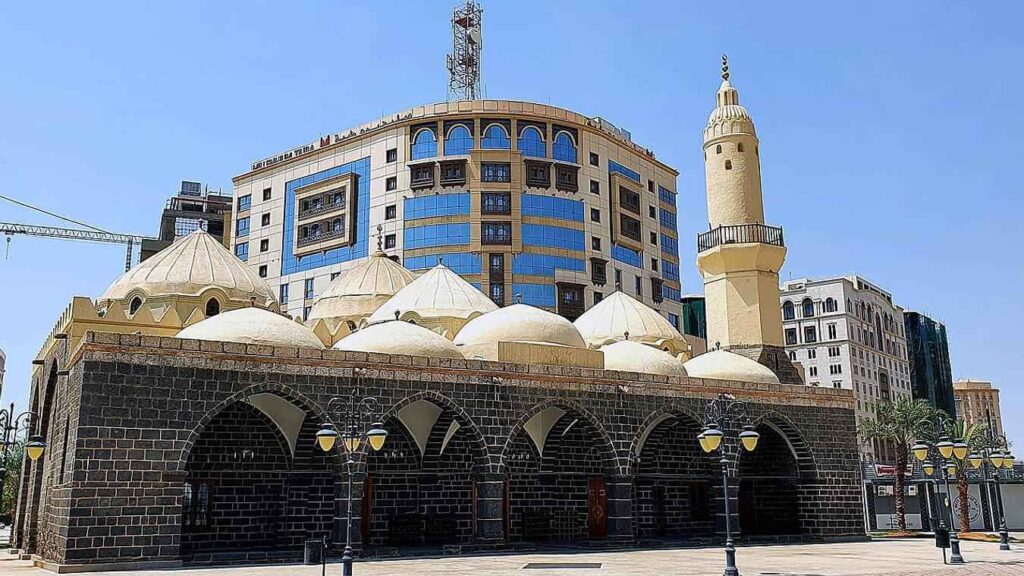
The current structure reflects renovation work carried out during the Ottoman period, including restoration attributed to Sultan Abdul Majeed I, and later preservation work during the Saudi era. The mosque is known for its distinctive domes and use of dark basalt stone, a building material common to older structures in Madinah’s historic core. The design is modest in scale compared to Masjid an-Nabawi, which reflects its role as a smaller, secondary site of historical significance rather than a major congregational mosque.
Where Is Masjid al-Ghamama Located?
Masjid al-Ghamama sits close to the western side of Masjid an-Nabawi, within easy walking distance for most visitors. Reported distances vary slightly between sources — figures ranging from roughly 200 to 500 meters from Masjid an-Nabawi appear across different references — so it’s best treated as “a short walk away” rather than an exact fixed distance. Its proximity makes it a natural stop either before or after visiting the Prophet’s Mosque, without requiring a separate dedicated trip.
Is Masjid al-Ghamama Open for Daily Prayers?
For a long period, Masjid al-Ghamama was not used for the five daily prayers because of its closeness to Masjid an-Nabawi, to avoid overlapping calls to prayer and congregation timings. More recent reports indicate the mosque has since reopened to worshippers for daily prayers, reportedly supported by sound-system adjustments to prevent audio overlap with Masjid an-Nabawi. Because operating status and prayer arrangements can change, visitors planning to pray there specifically should confirm current arrangements locally rather than relying solely on any single online source.
What to Expect When You Visit
A visit to Masjid al-Ghamama is typically brief and low-key compared to major Ziyarat sites. There’s no large crowd management or ticketing process — visitors generally walk up, view the exterior and courtyard, and step inside where prayer is permitted. Given its size, it’s not a long stop; most visitors spend a short amount of time here before continuing to nearby sites or back toward Masjid an-Nabawi.
Because it sits so close to Masjid an-Nabawi, many pilgrims combine it naturally with a walk around the wider Nabawi precinct rather than treating it as a separate excursion.
How to Include Masjid al-Ghamama in Your Madinah Ziyarat Itinerary
Given its location, Masjid al-Ghamama fits well into a Ziyarat plan in a few ways:
- As a walking stop near Masjid an-Nabawi — since it’s within walking distance, it can be added to a morning or evening walk around the Prophet’s Mosque without needing transportation at all.
- As part of a wider central Madinah Ziyarat route — visitors combining several nearby historical sites in central Madinah sometimes include it alongside other short, walkable stops.
- As one stop within a broader multi-site Ziyarat trip — for visitors also planning to visit sites further from the city center, such as Quba Mosque, Masjid al-Qiblatain, or Uhud, Masjid al-Ghamama can be worked into the start or end of that route since it’s so close to central hotels and Masjid an-Nabawi.
Because it doesn’t require a long detour, it’s often treated as a “bonus” stop rather than the centerpiece of a Ziyarat day — but it adds meaningful historical context for relatively little extra time.
Getting to Masjid al-Ghamama: Transportation Options
Because of its short distance from Masjid an-Nabawi, many visitors simply walk to Masjid al-Ghamama. For those staying further from the central area, combining a walk with private transportation for the rest of a Ziyarat route is often more practical — particularly when the plan includes sites that are further apart, such as Quba, Qiblatain, or Uhud, where public transport schedules can make multi-stop planning difficult.
This is where private transportation becomes genuinely useful rather than just a convenience. A private Ziyarat taxi allows visitors to structure their own route — starting near Masjid an-Nabawi, stopping briefly at Masjid al-Ghamama, and continuing on to other Ziyarat sites — without needing to plan around fixed public transport timings or arrange separate transport for each stop.
For families traveling with children or elderly relatives, or for groups wanting to move between several sites without splitting up, a private vehicle with hotel pickup and drop-off removes a lot of the logistical friction from the day. Visitors looking for private transportation can contact Madinah Ziyarat Taxi through WhatsApp at +966 57 4915 372 to ask about availability, vehicle options, pickup arrangements, or a customized Ziyarat itinerary that includes Masjid al-Ghamama alongside other historical sites.
Visitor Tips and Etiquette
- Dress modestly, as you would for any mosque visit in Madinah.
- Keep noise to a minimum, particularly if others are praying or reflecting inside.
- Since the mosque is small, visits during quieter times of day tend to be more comfortable, especially for older travelers or anyone wanting a calmer experience.
- During Ramadan and peak Umrah or Hajj-season periods, foot traffic around the wider Masjid an-Nabawi area increases significantly, which can affect walking routes and timing — build some flexibility into your plans during these periods.
- Photography should be respectful and should not disturb worshippers.
- Carry water, especially if visiting during Madinah’s hotter months, since outdoor walking between nearby sites can add up.
FAQ
1. What is Masjid al-Ghamama?
Masjid al-Ghamama is one of Madinah’s oldest historic mosques, located a short distance from Masjid an-Nabawi. It is associated with several events from the life of the Prophet Muhammad ﷺ, most notably the rain prayer (Salat al-Istisqa).
2. Why is it called the “Mosque of the Cloud”?
“Ghamama” means cloud in Arabic. According to historical reports, clouds gathered and rain fell shortly after the Prophet ﷺ led a prayer for rain at this location, and the site was later named after that event.
3. Where is Masjid al-Ghamama located?
It is located a short walk from Masjid an-Nabawi, on the western side. Reported distances vary between sources, roughly in the 200–500 meter range, so it’s best understood as being within easy walking distance rather than an exact fixed figure.
4. Is Masjid al-Ghamama open for the five daily prayers?
Historically, it was closed for daily prayers due to its closeness to Masjid an-Nabawi. More recent reports suggest it has reopened to worshippers, but arrangements can change, so it’s worth confirming locally if this matters to your plans.
5. Is Masjid al-Ghamama connected to Eid prayers?
Yes. Multiple historical sources report that the Prophet ﷺ performed Eid prayers at this site during the later years of his life.
6. Is the funeral prayer for Najashi really linked to this site?
Some historical reports associate this location with the funeral prayer the Prophet ﷺ performed in absentia for Najashi, the ruler of Aksum. As with several details connected to this mosque, this is described in historical tradition rather than as a single confirmed record, so readers interested in the precise historical account should consult established Islamic historical sources.
7. How long does a visit to Masjid al-Ghamama take?
Because of its smaller size, most visits are brief — generally a short stop rather than an extended visit, especially compared to larger Ziyarat sites.
8. Can I combine Masjid al-Ghamama with other Ziyarat sites in one trip?
Yes. Its closeness to Masjid an-Nabawi makes it easy to combine with a walking route around the Prophet’s Mosque, or to include as one stop within a wider multi-site Ziyarat trip that covers other historical locations in and around Madinah.
9. Do I need transportation to visit Masjid al-Ghamama?
Not necessarily – many visitors simply walk there from Masjid an-Nabawi or nearby hotels. Transportation becomes more useful when combining this stop with other Ziyarat sites that are further apart.
10. Can I book a private Ziyarat taxi that includes Masjid al-Ghamama?
Yes. Private Ziyarat taxi services can build a custom route that includes Masjid al-Ghamama along with other sites. Visitors can contact Madinah Ziyarat Taxi via WhatsApp at +966 57 4915 372 to discuss options.
11. Can the taxi pick me up from my hotel?
Private Ziyarat taxi services generally offer hotel pickup and drop-off as part of door-to-door transportation. Specific arrangements can be confirmed directly with the provider.
12. Is private transportation useful for families or elderly travelers visiting Ziyarat sites?
It can be, particularly when a Ziyarat plan includes multiple stops spread across Madinah. Private transportation allows the group to move at its own pace without depending on public transport schedules, which can be especially helpful for elderly travelers or families with young children.
13. What should I wear when visiting Masjid al-Ghamama?
Modest clothing is expected, consistent with visiting any mosque in Madinah.
14. Is Masjid al-Ghamama suitable for a first-time Ziyarat visitor?
Yes. It’s a straightforward, easily accessible stop that doesn’t require special arrangements, making it a good addition even for visitors new to Madinah.
15. Is there an entrance fee to visit Masjid al-Ghamama?
No fee information has been independently verified for this guide. Visitors should check current, official information locally rather than relying on unverified figures.