Quba Mosque: History, Significance, and a Practical Visitor Guide
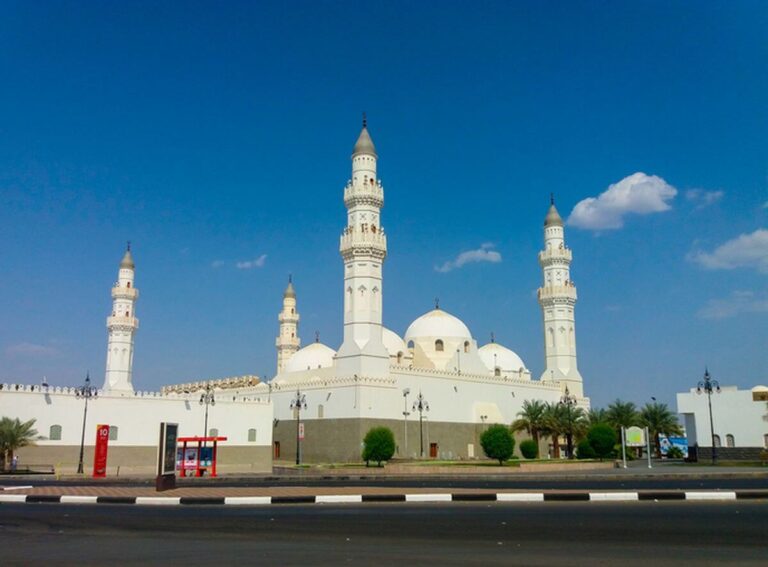
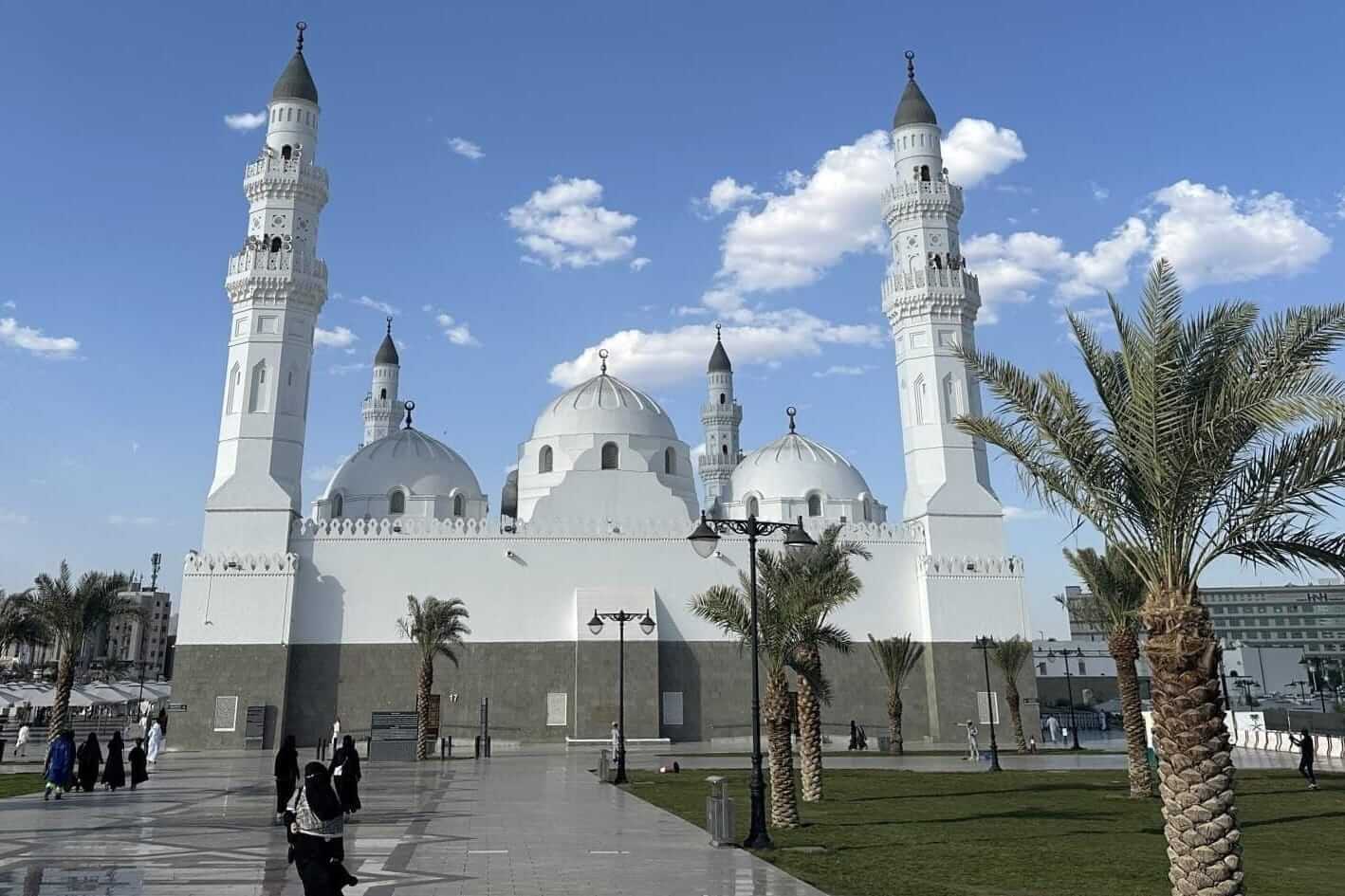
Quba Mosque, known in Arabic as Masjid Quba, is the first mosque built in the history of Islam. Located on the outskirts of Al-Madinah Al-Munawwarah, it holds a place in Islamic history that goes back to the earliest days of the Muslim community — and it remains one of the most visited Ziyarat sites for pilgrims and travelers in Madinah today.
This guide covers the mosque’s history, its religious and historical significance, what the site looks like today after recent development, and practical information for visitors planning to include it in their Madinah Ziyarat itinerary.
What Is Quba Mosque?
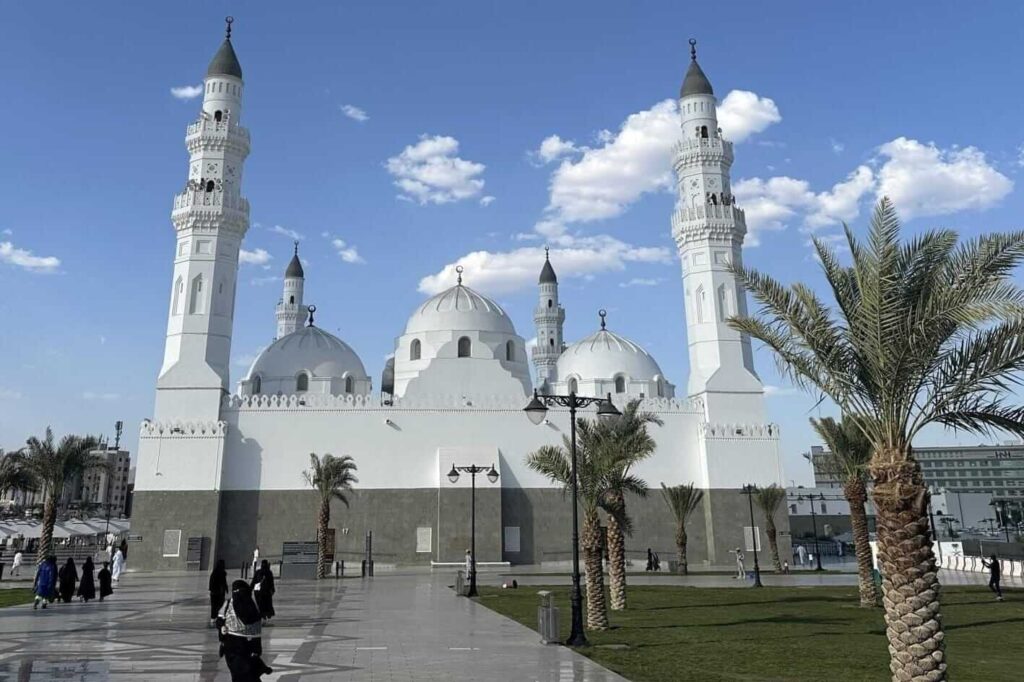
Quba Mosque is widely recognized as the first mosque built in Islamic history. It was the first mosque to be built by the Prophet Muhammad ﷺ after his arrival in Madinah from Makkah, and it is situated approximately 3.25 kilometres from Masjid Nabawi — with Saudi heritage sources placing the distance at approximately 3.5 km southwest of the Prophet’s Mosque, on Hijra Road. It is overseen by the al-Madinah Region Development Authority. The mosque holds deep historical meaning for Muslims and continues to function as an active place of worship, drawing visitors throughout the year, with a noticeable rise during Ramadan and peak Umrah and Hajj seasons.
The History of Quba Mosque
Quba Mosque was constructed in 622 CE, marking it as one of the oldest mosques in the world. According to Islamic historical accounts, the mosque stands on the spot where the Prophet Muhammad ﷺ and his companion Abu Bakr first stayed after migrating from Makkah to Madinah, arriving on the 12th of Rabi al-Awwal, a Monday.
The Prophet himself took part in laying its foundation, placing the first stones, while his companions completed the construction that followed. This shared effort — involving the Prophet, his companions, the Muhajireen (Muslims who migrated from Makkah), and the Ansar (Muslims of Madinah) — is often cited as an early example of communal cooperation in building Islamic institutions.
Historical sources also note that Quba Mosque was the site of the first congregational Friday prayer in Islamic history, before the construction of Masjid an-Nabawi in central Madinah.
Over the centuries, the mosque has been renovated and expanded multiple times. The first renovation took place during the era of the Rashidun Caliphs, when Uthman ibn Affan refurbished the structure. Later, Umar ibn Abdulaziz added new structures along with the mosque’s first minaret, work generally dated to between 705 and 712 CE. Further renovations followed under Abu Yaela al-Husayni in 1044 and Jamal al-Din al-Isfahani in 1161.
Why Quba Mosque Is Significant to Muslims
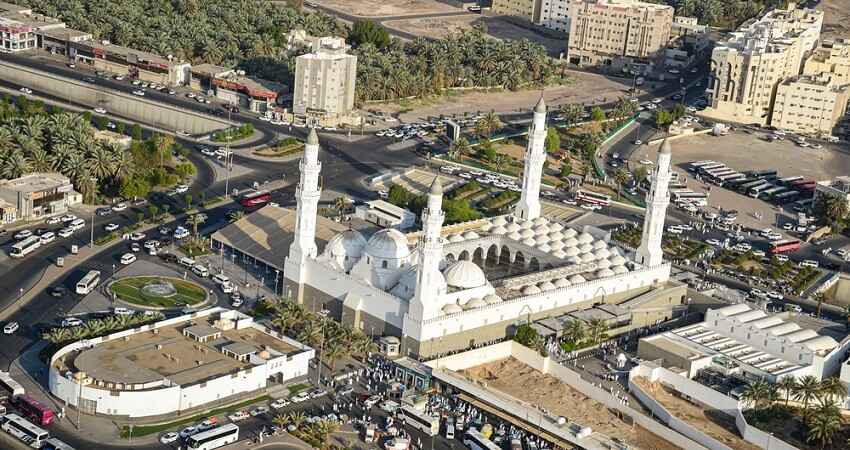
Quba Mosque’s importance is both historical and spiritual, and the two are closely connected.
Historical significance: As the first mosque built in Islam, Quba represents the founding moment of organized Muslim worship after the Hijra, and it is directly tied to the Prophet’s arrival in Madinah.
Religious significance: Several hadith collections record traditions describing the reward associated with praying at Quba Mosque. One narration frequently cited by Islamic scholars states that performing ablution at home and then praying at Quba Mosque carries a reward similar to that of performing an Umrah. This tradition is one of the main reasons pilgrims prioritize a Quba visit during their time in Madinah.
It is worth noting for visitors: a visit to Quba Mosque is a recommended (mustahabb) Ziyarat practice rooted in tradition, not a mandatory ritual of Hajj or Umrah. Travelers planning their pilgrimage should rely on qualified religious guidance for questions about specific rulings, while treating the historical and cultural information in this guide as background for planning their visit.
Quba Mosque Today: Location, Size, and the King Salman Expansion
Quba Mosque is located southwest of Al-Madinah Al-Munawwarah, on Hijra Road, roughly 3.5 km from the Prophet’s Mosque.
The mosque you see today is significantly larger than its historical footprint, and it continues to grow. Before the current expansion project, the mosque’s praying area covered around 5,000 square meters, with the building and its facilities occupying 13,500 square meters and a total capacity of about 20,000 worshippers.
In April 2022, the King Salman Project to Expand Quba Mosque was launched, aiming to raise the mosque’s total area to 50,000 square meters — roughly ten times its previous size — with a projected capacity of about 66,000 worshippers.The project forms part of Saudi Vision 2030, falling under the Kingdom’s programs for pilgrim experience and quality of life, and it also includes the development and revival of dozens of nearby historical sites, wells, farms, and orchards, alongside three historic paths associated with the Prophet’s journey.
Importantly, the original core structure of the mosque — the part built during the Prophet’s lifetime — is being preserved rather than altered, with the expansion built around and alongside it.The mosque grounds and courtyard use heat-reflective marble, and the courtyard is shaded by retractable fiberglass-fabric canopies that can be folded or unfolded as needed, helping worshippers cope with Madinah’s heat.
Because construction projects of this scale unfold in phases, visitors should be aware that access routes, parking areas, or specific sections of the mosque complex may change over time as work progresses. It’s a good idea to check current conditions close to your travel dates rather than relying on older photos or descriptions.
Planning Your Visit to Quba Mosque
Quba Mosque is open for daily prayers, and it is one of the largest mosques in Madinah, hosting daily prayers as well as Friday and Eid prayers. Most visitors combine a Quba visit with prayer, since arriving in time for one of the five daily prayers allows you to pray inside the mosque rather than simply viewing it from outside.
A few practical planning points:
- Time of day: Many visitors prefer to time their trip around Fajr, Maghrib, or Isha prayers, when the temperature is cooler, particularly in summer months.
- Duration: A visit typically involves prayer plus some time to view the mosque and its surroundings. Exact durations vary by crowd levels and personal pace, so it’s best to allow a flexible window rather than a fixed number of minutes.
- Peak periods: Ramadan, and the Hajj and peak Umrah seasons, tend to bring larger crowds to Quba Mosque, as they do to most Madinah Ziyarat sites. Traveling slightly outside of prayer-time rush, where your schedule allows, can make the visit more comfortable.
- Ongoing development: As noted above, the King Salman expansion project means some areas around the mosque may be under construction depending on when you visit.
Getting to Quba Mosque from Madinah Hotels or Masjid an-Nabawi
Quba Mosque sits a few kilometers from the central Masjid an-Nabawi area, where most Madinah hotels are concentrated. Because it is outside walking distance for most visitors — particularly families, elderly travelers, and anyone visiting in the heat — the trip is usually made by taxi, private car, or organized Ziyarat tour rather than on foot.
This is where private transportation becomes genuinely useful rather than just convenient. A hotel-pickup taxi service removes the need to arrange public transport schedules or negotiate transport on the spot, which matters most when you’re also planning to visit other Ziyarat sites in the same trip — such as Masjid al-Qiblatain or the sites around Mount Uhud — since each additional stop adds its own transportation question.
Visitors looking for private transportation to Quba Mosque and other Madinah Ziyarat locations can contact Madinah Ziyarat Taxi through WhatsApp at +966 57 4915 372 to ask about hotel pickup, available vehicle options, and a Ziyarat route that fits their schedule.
Visiting Quba with Family, Elderly Travelers, or a Group
Quba Mosque welcomes a wide range of visitors, from solo pilgrims to large family groups, and different travelers tend to have different practical needs on the way there:
- Families with children often benefit from a private vehicle that allows for a direct hotel-to-mosque trip without transfers, plus the flexibility to leave whenever the group is ready rather than working around a fixed group-tour schedule.
- Elderly travelers generally find door-to-door pickup and drop-off more comfortable than walking longer distances between transport points, especially in warmer weather.
- Groups visiting several Ziyarat sites in one outing — for example, combining Quba Mosque with Masjid al-Qiblatain and other historical stops — often find that a single private vehicle for the whole trip is simpler than coordinating multiple taxis or public transport legs between each site.
Where a private Ziyarat taxi is used, the choice of vehicle usually depends on group size — a sedan works well for a couple or small family, while a larger van or SUV suits bigger families or groups traveling together for a half-day or full-day Ziyarat itinerary.
Visitor Etiquette and Practical Tips
- Dress modestly, as you would for any active mosque in Madinah.
- Carry water, particularly if visiting during the warmer months, and dress for the heat while still keeping modest coverage.
- Non-Muslim visitors interested in the site’s historical and architectural significance should check current entry policies for the prayer hall in advance, as access rules at active mosques in Madinah can differ from general tourist attractions.
- Photography is generally acceptable in outer courtyards, but be respectful of worshippers who are praying, and avoid photographing people without their consent.
- If visiting during Ramadan or peak Umrah/Hajj season, allow extra time for parking and movement around the site due to higher visitor numbers.
- Since the mosque complex is undergoing phased expansion, some walking routes or entry points may shift — following posted signage or asking your driver/guide for the current layout is the simplest way to avoid confusion.
Quba Mosque and Other Madinah Ziyarat Sites
Quba Mosque is usually one stop within a broader Madinah Ziyarat itinerary rather than a single standalone destination. Depending on time available, visitors often combine it with other historically significant sites in and around Madinah, such as Masjid al-Qiblatain (where the direction of prayer was changed from Jerusalem to Makkah) or the area around Mount Uhud, site of the Battle of Uhud.
Because these locations are spread across different parts of the city, a private Ziyarat taxi that can move between multiple stops — with hotel pickup at the start and drop-off at the end — tends to be more practical than arranging separate transportation for each site individually. This is particularly relevant for visitors on a tighter schedule, such as those combining Ziyarat with a short Umrah trip.
FAQs
1. What is Quba Mosque?
Quba Mosque (Masjid Quba) is widely recognized as the first mosque built in the history of Islam, constructed shortly after the Prophet Muhammad’s ﷺ migration (Hijra) from Makkah to Madinah in 622 CE.
2. Where is Quba Mosque located?
It is located southwest of Al-Madinah Al-Munawwarah, on Hijra Road, approximately 3.5 km from Masjid an-Nabawi (the Prophet’s Mosque).
3. Why is Quba Mosque important to Muslims?
It marks the site of the first organized Muslim place of worship after the Hijra, and hadith traditions describe a spiritual reward, similar to that of an Umrah, for those who pray there after performing ablution at home.
4. Is visiting Quba Mosque a required part of Umrah or Hajj?
No. Visiting Quba Mosque is a recommended Ziyarat practice rooted in tradition, not an obligatory ritual of Hajj or Umrah. For specific religious rulings, consult a qualified scholar.
5. How far is Quba Mosque from the hotels near Masjid an-Nabawi?
Most Madinah hotels are clustered near Masjid an-Nabawi, and Quba Mosque is roughly 3.5 km away — generally considered too far for a comfortable walk for most visitors, especially in warm weather.
6. How can I get to Quba Mosque from my hotel?
Most visitors travel by taxi, private car, or an organized Ziyarat tour. A private Ziyarat taxi with hotel pickup is a common choice, particularly for families, elderly travelers, and groups.
7. Can I book a private taxi for Quba Mosque and other Ziyarat sites?
Yes. Private Ziyarat taxi services, including Madinah Ziyarat Taxi, offer hotel pickup and multi-stop itineraries that can include Quba Mosque alongside other Madinah historical sites.
8. Is private transportation useful for families visiting Quba Mosque?
Many families find it useful because it allows direct hotel-to-mosque travel, avoids coordinating separate transport for each Ziyarat stop, and offers more flexibility around timing than a fixed group schedule.
9. What vehicle is suitable for a group visiting several Ziyarat sites?
This generally depends on group size — a sedan suits a couple or small family, while a larger van or SUV is often more practical for bigger families or groups traveling together for a half-day or full-day Ziyarat itinerary.
10. How long does a visit to Quba Mosque take?
This varies depending on prayer timing, crowd levels, and how much time you spend at the site, so it’s best to allow a flexible window rather than expecting a fixed duration.
11. Can non-Muslims visit Quba Mosque?
Access policies at active mosques in Madinah can vary, particularly for the prayer hall itself. Non-Muslim visitors interested in the site should check current entry conditions before planning a visit.
12. Has Quba Mosque been renovated recently?
Yes. In April 2022, the King Salman Project to Expand Quba Mosque was launched, aiming to increase the mosque’s total area to 50,000 square meters and its capacity to around 66,000 worshippers, while preserving the mosque’s original historic core.
13. What is the best time of day to visit Quba Mosque?
Many visitors prefer traveling around Fajr, Maghrib, or Isha prayer times, both to pray inside the mosque and to avoid the heat of midday, particularly during summer.
14. Can I combine a Quba Mosque visit with other Madinah Ziyarat sites in one trip?
Yes. Quba Mosque is commonly combined with other historical sites in Madinah, such as Masjid al-Qiblatain, as part of a broader half-day or full-day Ziyarat itinerary.
15. How do I contact Madinah Ziyarat Taxi to arrange a visit?
Visitors can reach Madinah Ziyarat Taxi via WhatsApp at +966 57 4915 372 to ask about hotel pickup, vehicle options, and customized Ziyarat routes, or visit https://madinahziyarattaxi.com/.